Problem
Kurdish Sorani has far fewer labeled speech resources and mature pretrained tools than high-resource languages, making accurate transcription substantially harder.
Low-resource language · Speech recognition
A speech-to-text system focused on Kurdish Sorani, tackling the data and modeling constraints of an underrepresented language.
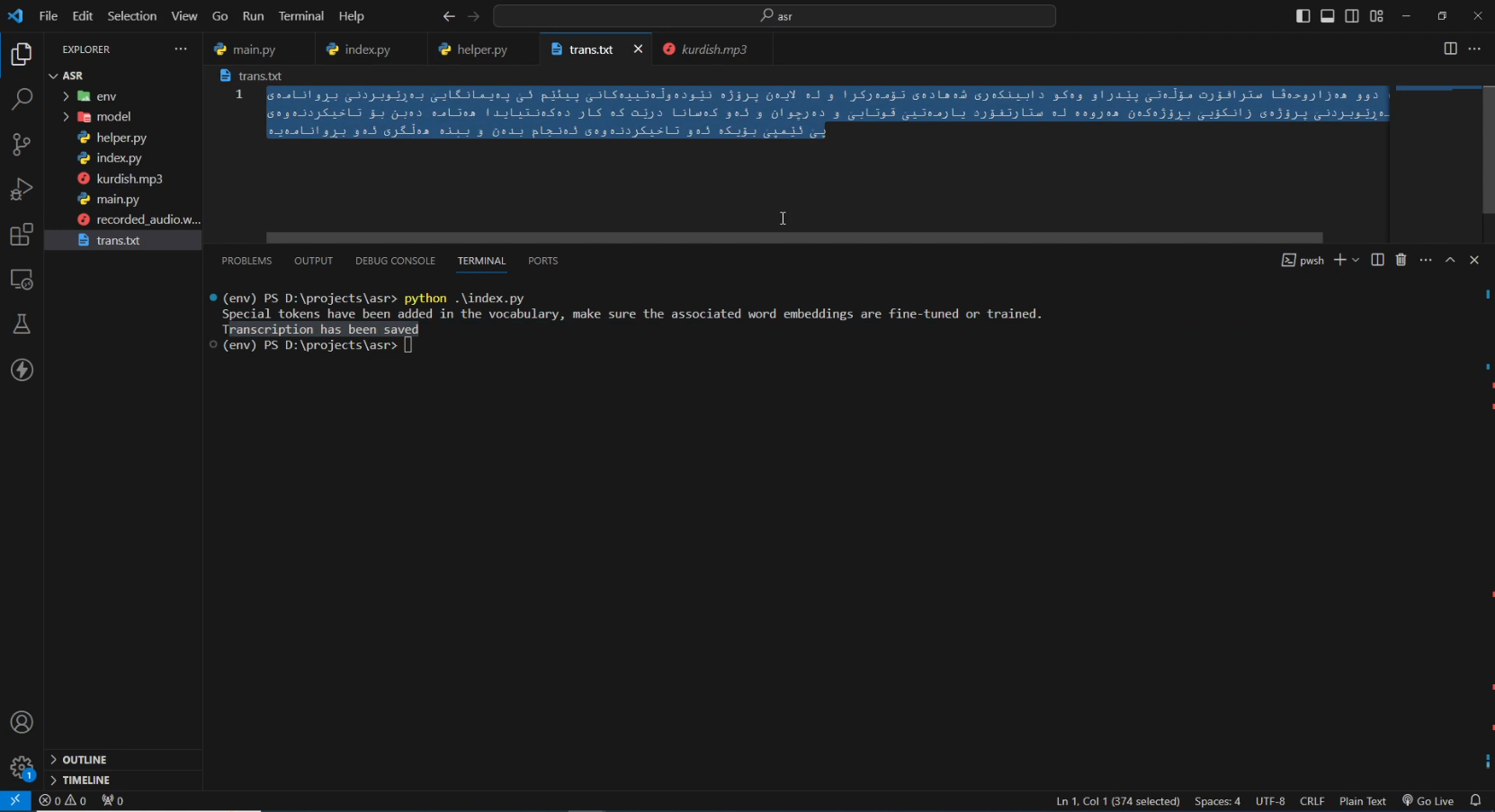
Kurdish Sorani has far fewer labeled speech resources and mature pretrained tools than high-resource languages, making accurate transcription substantially harder.
The work centered on preparing the audio pipeline, adapting recognition models and building an interface that made the resulting transcription capability usable.
End-to-end speech pipeline
Work on an underrepresented language
Model-to-interface integration
Foundation for accessible transcription
The strongest next step would be a transparent benchmark set covering speakers, environments and dialect variation before making accuracy claims.